Sunday, July 1, 2018

My First ALA Experience: The Appetizer

Friday was the first official day of the ALA conference. Thanks to a tweet that was shared a weeks before the conference, I knew that my primary focus was to attend the Q&A between Michelle Obama and Dr. Carla, Hayden.  I had never heard either of the women speak in person before and I was excited. The first focus was to get breakfast and hope that the food would tide me over as I waited in the anticipated long lines to see and hear the former, first lady. First, I had a meeting to attend.

After a quick breakfast and attendance at the BCALA Executive Board meeting, my mom and I caught the shuttle to the convention center. As soon as we got off the shuttle, we headed to the information booth to determine where we should go to see Mrs. Michelle Obama.  We were told to go to hall H. At 10:30 am, the line was quite long.  Focused on our intent, we got in line. About an hour into sitting, my mom headed over to the Exhibit Hall.

Thankfully, I had Dan Chan, an artist and writer for numerous zines, and other line mates to keep me company.  I also met a future, BCALA board member and her daughter.  The wait was interrupted by an impromptu moment of cheering for Dr. Carla Hayden who walked past the line. It was once we entered the hall that the real party began.

I happened to sit behind a group of women who were equally enthusiastic about the music playing in the hall.  What began as individual seat dancing led to an impromptu Soul Train line.  We also passed the time by guessing the name of songs and sharing info about ourselves.  One of my seatmates shared my excitement about Dr. Hayden and was willing to be my photographer as I tried to get a close-up picture of one of the gurus in the library world.

A few minutes after 4 o'clock, the hall filled with the sounds of live music and we saw a group of teenagers on stage playing instruments.  I learned they were a group of musicians brought together by Trombone Shorty, a well-known jazz musician and children's book author. The infectious sounds made us clap our hands and pat our feet.  I was especially impressed to see a young lady leading the band before Trombone Shorty came on stage. Next, we were provided with words of encouragement by Jim Neal, the President of ALA, as well as an introduction of the new board and upcoming President of ALA, Loida Garcia-Febo. After his introduction, we received more words of encouragement and recognition by the mayor of New Orleans, Mayor Cantrell.  Then, we were introduced to  Mrs. Michelle Obama.

An intimate conversation between the former First Lady and the Dr. Hayden, the two engaged in a conversation regarding Mrs.Obama's memories of her time in the White House, as well as her gratitude for her parents, her parenting style, and her love of books. Mrs. Obama also remarked on the way books allowed her a chance to "get out of her own way" and take a break from the outside world.  Her words were sweet to the ears of the audience of librarians and bibliophiles.  An added bonus was the relaxed style of the conversation between the two and the feeling that we were a part of an intimate conversation between friends.

After the discussion, I hugged my seatmates. We held back tears as we marvelled at the moments we had just witnessed. A wonderful beginning to the conference, I knew the rest of my ALA adventure would be just as satisfying.


Friday, June 29, 2018

My First ALA Experience: The Amuse-Bouche

For the past five years, I have spent this time of the year at the International Society for Technology in Education conference (ISTE).  A conference focused on technophiles and education movers and shakers, ISTE has been the jam that I have spread on my PLN bread for numerous years. My first ALA experience was a memorable and sweet. Set in New Orleans, the American Library Association conference was not only a wonderful experience it was life altering.

First, I want to mention my travel companion for the conference.  My mom.  The Lucy to my Ethel, she and I rediscovered the joys of travelling together last year at the Black Caucus of the American Library Association Conference.  A gregarious person who has a way of making people feel appreciated and alive, my mom is a compliment to my sometimes stoic facade at conferences.  Always scoping out the lay of the land, my mom has a way of warming of the crowd and making everyone feel as they have met a long lost friend.

The first day in New Orleans, was spent searching for beignets.  The weeks prior to the conference, I had shared with anyone who would listen that my plan was to have a beignet everyday.  Prior to the conference, my only experience with beignets was at a Cajun
Festival decades ago in Virginia.  Thanks to number of food shows, my desire to try the flaky, warm pastry again was enhanced as I planned for the trip to NOLA.

Walking along Royal Street, we saw many sights and sounds.  The number 300 displayed on steps to commemorate New Orleans' tricentennial birthday. The sound of music coming from various shops and riverboats.  The smells of various foods in restaurants.  Eventually, we found Cafe Du Monde.  After quite a wait for service, we chose to go to Cafe Beignet (a block or so away).  Our selection was not a disappointment. We were able to get quick service and the wait for the beignets was minimal.

No words can describe my joy when I saw that the order was an established number of three beignets. My mom was a bit shocked that I seemed intent on eating three beignets at one time and suggested that I save one or two for later.  "They aren't the same cold," I told her as my eyes glazed over at the sight before me.  Shaking her head, she sipped her lemonade.

Warm and flaky, the sweet pastry was better than I remembered. In this case, Sade was wrong.  It was better than the first time.  Each bite was a journey. The first bite was euphoric. The second bite was sublime. The third bite was nirvana. Intent on not wasting too much of my beignet experience, I ate the corners of the other two.

Intent on walking off a few of the calories from the beignets and seeing a few more sights in New Orleans, my mom and I walked to Canal Street to catch a trolley.  During the ride, we met other first time visitors to NOLA  and discovered a few shotgun houses that reminded me of my father's childhood home.

Intent on getting my badge and bag before the first day of the conference, I convinced my mom to catch the shuttle with me to the Convention Center.  In hindsight, this was a good move because it allowed us to have more time for the long line that awaited us the first day of the conference.

Next Blog Topic: My First ALA Experience: The Appetizer

Tuesday, March 20, 2018


I wanted to share a review for the novel, Long Way Down, by Jason Reynolds.


Tlovesbooks rated a book it was amazing
Long Way Down by Jason Reynolds
Long Way Down
by Jason Reynolds
recommended for: all
Did he
or
didn't he?

Written like a poem.
Chapters
Stanzas
brief
and filled with imagery
that tug at your heart.
In the end, you wonder...
did he or didn't he?

Each descent with a deceased family member,
childhood friend,
and
family foe
seems to foreshadow
the
c
  h
   a
     i
       n
of gun violence,
loss
and
death.
Did he or didn't he?

Written in free-verse, the novel tells the story of Will.  A young man still learning the ways life, Will's brother is killed by an unknown gunman.  Using the rules taught to him to his brother, Will is determined to get revenge for is brother's death.  It is during his ride in the elevator that he encounters people from his past who were killed by gun violence.  


A poignant read that will hurt your heart and may cause you to read the book in short spurts, Long Way Down is a timely work that will attract young readers and anyone who enjoys YALit.


Friday, March 16, 2018

Who knew that a tweet would lead me to step out of my comfort zone?  

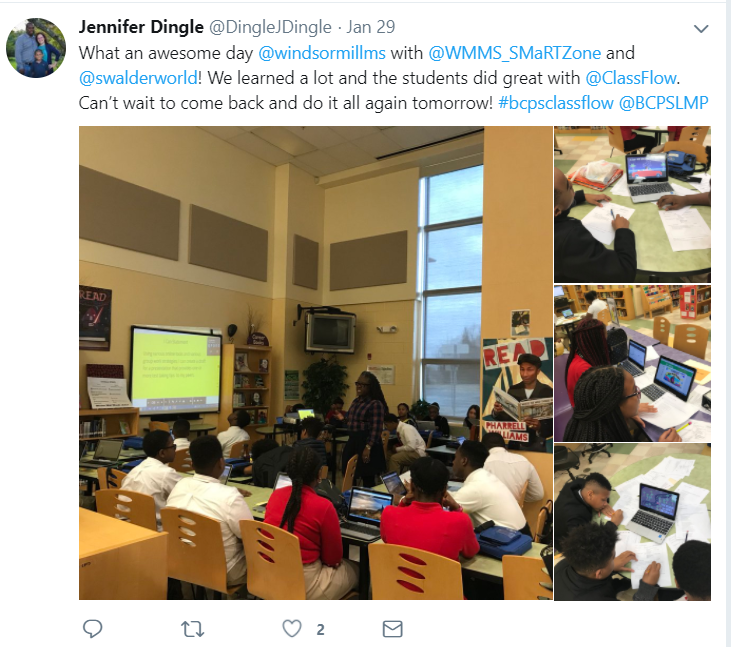
Anyone who knows me, realizes I tend to be a creature of habit. I also don't like to do something that I am not "good at." ClassFlow was that something.  Reintroduced to it in August during a library media specialist professional development,  I was intrigued by the tools that were offered. From collaboration to individual assessment, it seemed to have everything I was looking for in an online resource. A week or so later, I tried to recreate a chart I could use with students during their library orientation.  For whatever reason, I couldn't figure out how to create the charts I had envisioned in my head.  The unfamiliarity led me to put ClassFlow on the shelf.  I changed my mind when I saw a Tweet.


The Tweet that started it all


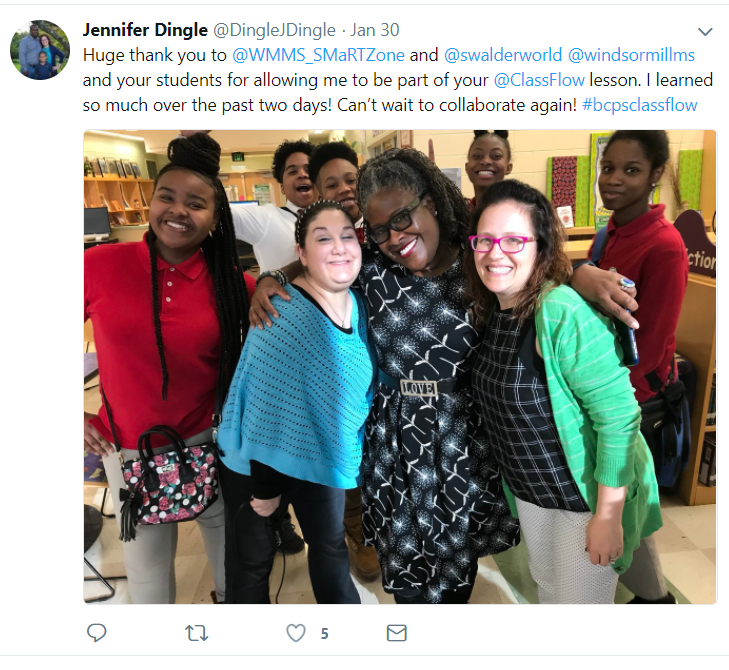
I was intrigued and contacted Jennifer Dingle to set-up a session.  Immediately, I was put at ease by her jovial manner.  No question was too embarrassing to ask and many of my ideas were exciting to her.  I shared with her that I wanted to use the tool for a lesson that was a week away.  A daunting task considering the lesson I envisioned required use of tools and tricks that veteran ClassFlow users tended to use, Ms. Dingle encouraged me to try it out and told me the steps I would have to complete. We set-up another date and time for a follow-up meeting to check my progress.


Planning was key


Long evenings at the school were my time to focus on the lesson and create the charts I wanted based on the notes and directions provided by Mrs. Dingle. The next few evenings reminded me of my first year as a teacher in Baltimore County Public School Systems.  Quite a bit of work was required to create slides students could edit as a group, as well as slides which linked students to Flocabulary videos related to a test taking strategy assigned to the group.   Realizing that some of the lesson needed to streamlined, I asked for the input of the classroom teacher I would present the lesson within the next week.  Mrs, Walder provided me with a list of nine literary topics that the students needed to focus on (text structure, summarizing, inferencing, etc.).  One more planning session with Jennifer Dingle, and I was ready to present the lesson to the class.


Placed in groups by their classroom teacher, students were given the task to watch a Flocabulary video and create a presentation for their peers. The presentations had to include two or more tips , an example the audience could try to answer, and the answer with an explanation. Working collaboratively with their peers on charts, students assigned roles to members within their groups and began to work on the presentation using ClassFlow.  For many of the classes, this was their first time using ClassFlow.


The first day of the lesson we had a few glitches; however, the lessons moved smoothly thanks to the presence of Mrs. Dingle. By the second day, we streamlined the lesson once again.  For some classes, the students would view the Flocabulary videos as a class and take notes for the tips provided using the notebook feature in ClassFlow.  For another class, students remained in their groups and completed their charts with test strategies and tips. Mrs. Walder agreed to grade the notebooks once the students shared their work with her.  


Thanks to a tweet, I was able to try a new technological tool, collaborate with a new partner, and enhance a lesson. I am so grateful I saw that Tweet and I am grateful I was able to enhance the learner centered environment in the library. Using ClassFlow was a wonderful way to engage the students and add rigor to the lesson. 


Saturday, January 13, 2018


Mid-Year Review (2017-2018)


The beginning of the school year, there were numerous plans to continue project based learning (PBL) in the school library.  I had visions of increased collaborations with teachers in the building and reached out to several people within our community, as well as my district.  Unfortunately, many of those plans were not able to be fully realized.  Whether there were teacher concerns for curricular demands (which is understandable) or fiscal constraints to visit a historian to assist students with a video montage of the history of the school, it was disheartening (to say the least) to see numerous ideas and plans become dismantled. Fortunately, things began to turn around once I spoke to a few trusted colleagues and received their input.


The first colleague to assist me was one of the school counselors in my school, Mrs. Thomas-Aulu.  Once I shared the vision for the library as a hub for learning she suggested we team up on a series of bullying lessons.  These lessons would meet the district demands for increased discussions regarding bullying and provide a way to work with some new teachers in our school building.  Working with Mrs. Thomas-Aulu during the first semester was a success.  The bullying lessons provided sixth grade students much needed information regarding the definition of bullying. Through the lessons, we provided suggestions for students to follow as they sought to become upstanders.


The second colleague to assist me was the STAT teacher in our school, Niamh McQuillan.  The previous year, she had been a major cheerleader for project based learning in the library.  I shared the list of PBLs I had hoped to do for the school year and shared the fact many of those plans were not going to be realized.  My primary concern at the time was that we would not have enough students to take part in a PBL opportunity with Baltimore Center Stage.


A few weeks before the school year ended, I received information regarding Baltimore Center Stage's Young Playwrights Festival (YPF).   Ms. McQuillan then began to help me think of ways to provide outreach directly to the students and parents within our school building. She suggested that I create a video that would entice the students to try the YPF opportunity in our school. Because I do not have a class of students of assigned to me, I needed to get the information to students and parents who were interested in the opportunity. Ms. McQuillan suggested that I visit classrooms to share the video and give students to get the permission slip to join the PBL. She also reminded me to utilize the contacts I had made in the previous year as way to continue the strides that we made in community and student engagement in the previous year.  Her advice was helpfulThanks to her suggestion, more students and parents signed-up for the YPF opportunity. I was excited at the possibilities of working with students as they recognized their creative gifts.

This excitement has continued into the New Year.  Instead of focusing on what goals we aren't meeting in the library, I chose to focus on the goals we have met and exceeded. This excitement was compounded when I created an infographic to showcase the successes in the school library during the first portion of the school year.  Using Piktochart, I created an infographic to show the highlights and stand-outs associated with our school year.


Looking at this information, I am excited about the possibilities for the school library program at Windsor Mill Middle School.  During the duration of the school year, I will continue to look at different ways to meet the goals I have set for The SMaRTZone Library. If those goals need to be revised, I will continue to use Ms. Thomas-Aulu and Ms. McQuillan as resources to help me determine any revisions I need to consider or new avenues I should utilize in order to meet the needs of our school community.


Wednesday, August 23, 2017

Using PBL to Create a Space for the Arts in the School Library (Part 1)

During the summer, I had a chance to share information regarding the project based learning (PBL) activities I worked on with students last year.  One of the PBLs I worked on involved an artist and an organization called Young Audiences of Maryland.

Young Audiences of Maryland (YAMD) is an organization that offers schools the chance to request various artists and performers for school assemblies, workshops, and residencies, the organization reached out to me to share an opportunity.  Each year, they offer schools in Maryland a chance to apply for a residency program.  Last year, I applied and our school was selected.  


First, were a series of meetings which allowed me a chance to meet the artist with whom I was paired. My partner was McKinley Wallace, a painter.  During the meetings, we shared our visions, meshed our ideas, and planned a series of lessons. YAMD did a wonderful job of preparing the artist with the expectations of sound lesson planning, as well as preparing me with knowledge of my role during the residency process. 


Next, Mr. Wallace met with the students before the lessons officially began.  He introduced himself and shared the proposed outcome of the lesson.  During the visit, the students had a chance to share information they had learned in previous lessons related to bullying.  This information was used a foundation for the four-panel mural that was created.   During a series of five lessons held in the library, the students were introduced to the basics of art and were able to apply their knowledge to the mural design.


The result was a beautiful four-panel mural which depicts four types of bullying: cyber bullying, verbal bullying, physical bullying, and isolation.  During the process, the students showed growth and it was a wonderful way to work with a classroom teacher that I had not had a chance to collaborate with in the past.  


The PBL also enhanced the perception the students and the classroom teacher had of the library program in our school.  Instead of seeing the library as just a place to store books, 
the students and classroom teacher found the space inviting and realized that the library was not just a place to store books but a place where they could be creative and express themselves using art.

Thursday, August 17, 2017

What can we do?: The Power of Educators

The past week has been a sea of emotions.  Last Thursday, I was reveling in my role as a school librarian.  As an first-time attendee of the National Conference of African American Librarians (NCAAL) in Atlanta, Georgia, I had the chance to meet authors that my students and I had talked about on numerous occasions.  Not only did I have a chance to meet Sharon Draper, Nikki Grimes, Susan G. Flake, Carole Boston-Weatherford, and Jason Reynolds, I was able to talk to them and ask questions.  

The conference was also a chance for me to meet with librarians in college libraries and public libraries. I was in heaven as we discussed ways to build communities within our library programs. I was entranced whenever someone shared new initiatives in their library spaces, and I was ecstatic when we could just sit down and talk about the various challenges we faced as librarians. In each encounter, there was honest conversation and a desire to make a positive difference in the lives of others. I felt empowered.

Cut to last Friday. I saw a few images on Twitter and I decided to skip the updates related to Charlottesville. I wanted to continue to bask in the glow of positivity at the conference. On Saturday, the glow of positivity changed.  By 2:30 pm, there was news of an incident. Without knowing the details, I prayed that there were no life threatening injuries.  By that evening, there were reports of three deaths. The talk at the conference turned to Charlottesville. We worried about those who were harmed. I prayed for those who had lost their lives.

On Sunday, as I listened to news reports. I grew even more concerned about the state of the world we live in (more specifically the state of the world my students live in).  Just two days prior, I had asked a group of strangers to pray for the children growing up today. Now on a bright, Sunday, I was faced with the realization that we needed to pray for our nation and the world in which we lived. Young and old, we all had some work to do.

The past few days, we have been inundated with images, press conferences, tweets, and news reels.  Each image a carrier of emotions for the speaker.  Each word a carrier of emotions for the viewer.  The question then becomes, what do we do with those emotions? How do we filter through the chaos and come through singed but not burned to a nothingness? How do we ensure that we don't fall into a state of decay?

Yesterday, a hashtag appeared on my Twitter feed that gave me a bit of hope.  #CharlottesvilleCurriculum appeared and I could have a moment of clarity. Educators can make a difference (if they choose) in their classrooms by trying to provide students with the necessary tools for empathy.  A variety of resources from the International Literacy Association (ILA) to EdWeek seem to be stepping stones for those who wish to discuss the incidents in Charlottesville with their students. 

The idea of empathy in the classroom is not a new one.  Last year, several teachers in my school building suggested that building a culture of empathy would be valuable for our students.  Last year, I had numerous conversations with my students to encourage them to put themselves in the shoes of others.  This morning, I read an article which quoted a former colleague and his desire to instill empathy in his students.  Empathy in the classroom is not a new idea; however, today, after the recent events in Charlottesville, is obvious that it is a topic that should be discussed.

Below this post is a Twitter Moment which highlights resources that educators may find helpful as they look for resources related to the #CharlottesvilleCurriculum. Here are a few preliminary resources I gathered using Destiny Collections (I also created a Part 2).  If anyone has any other ideas of resources, please let me know and we can share them with others.


“Tell me and I’ll forget; show me and I may remember; involve me and I’ll understand.”
Chinese proverb

Let's involve our students in a solution. Let's involve ourselves.

Reading for Empathy: #CharlottesvilleCurriculum

Check out @tlovesbooks's Tweet: https://twitter.com/tlovesbooks/status/898260143099588608?s=09

Wednesday, June 21, 2017


My excitement and nervousness for ISTE17 is increasing each and every day.  Why?

I'm excited to attend the conference. I'm always excited to attend ISTE.  The chance to be among other educators who are enthusiastic about teaching and technology makes me smile.  I also look forward to reconnecting with people I met last year. By chatting and catching up with members of my virtual tribe, we have a chance to share and engage with others. This year, I will have the chance to learn about new resources and share some of my own teaching experiences with others.  This leads to why I am nervous..

I will present a session this year. My session is titled, How LMSs can Increase Engagement with PBLs.  Proposed as a poster session, I was ecstatic when I received a request to do a snapshot.  Once the excitement wore off (it really never did) I became nervous. How would I fit the three PBL experiences in thirty minutes?  Would people attend?  Would others be excited about this topic?

I welcome the chance to find out. If you are interested in learning a bit more about PBLs, or would like to gain some ideas for ways to engage the students in your library program, come and check-out the session. It will be on Wednesday, June 28, 2017. Located in 225AB, the session will begin at 8:30 am.  Check out the ISTE app to sign-up.

I also have the opportunity to share the revamped style of PD in my school. In a session titled, Inside Out PD, my colleagues and I will discuss the premise for the teacher centered PDs at our school.  This session will be on Wednesday, June 28, 2017 and begins at 1:00 pm.  The session will be Ballroom 4.

For those who are unable to attend, I have a few hashtags that may be helpful:
#ISTE17
#PresentersOfISTE

Thursday, April 20, 2017

Building a Foundation for Project Based Learning in the Library


For many public school librarians the quest to collaborate with teachers is full of questions.  When do you find time to collaborate?  How can library media specialists connect the varied standards to the lesson?  How do we maintain a balance of teaching, guiding, and assessing during a lesson?  What are the expectations of the library media specialist once the lesson is complete?  How do you promote the work you do inside and outside of the library’s walls?  For this library media specialist, finding the answers to these questions was ongoing.  It was once I learned about project based learning (PBL) that I was able to gain some insight. 

Last year, the idea of project based learning was introduced to me from my coursework.  It was once I was introduced to the philosophy of John Dewey (there’s more to him than just the Dewey Decimal system) I was intrigued by the idea of giving students a chance to work on tasks related to their interest, engage the community, and provide opportunities for learning in a fun way.  I was introduced to other ways of assessment once I viewed the documentary, Most Likely to Succeed: Project Based Learning in the 21st Century.

The documentary highlights the accomplishments of High Tech High.  A charter school in California, High Tech High is a school based on the premise that students learn by doing.  Letter grades are not given to students; instead, within each subject area, students receive information regarding selected units and topics of their teachers.  Based on these units, the students are given a problem to solve or a broad project idea.  After receiving the basic parameters for the project, students (usually in groups) create a project that can be shared to a panel of teachers and then in a public showcase to parents and members of the community.

After viewing the film and completing my research of John Dewey’s educational philosophy, the idea of creating PBL opportunities for my students at Windsor Mill Middle School became a focus for me. I began to ask myself a new set of questions. How could I create opportunities for PBL within the library program?  How could I involve teachers? What role would the community have in the PBL projects?  

I will share information regarding the collaboration and the engagement of students and teachers in another blog post titled, Using PBL to Create a Space for Art in the Library.  


Sunday, April 2, 2017

#EduMatch Tweet & Talk 84: Student Choice and Engagement

Great discussion tonight regarding Student Choice and Student Engagement.  This was a great way to share techniques that educators use with their students, as well as a way to learn from others.  I discovered a few new techniques and will work to incorporate them in my lessons, before the school year ends.  Check out the link to the talk on YouTube.  Thank you @Edu_Match for facilitating this dialogue and for bringing educators together.

Saturday, March 25, 2017

Part Two: Influences on my Focus for the Library Program (2016-2017)

In a previous post, I shared information regarding the ways my course work and a summer institute helped to provide me with a new focus for the library program.  In part two, I would like to the ways a conference in Denver, Colorado was another catalyst for my revised vision of the library program.

The International Society for Technology (ISTE) conference is one of my favorites;  I compare it to Disneyland for Tech and Education Enthusiasts (Geeks).  Last summer, my joy was quadrupled by chance encounters, inspiring key note speeches, and connecting with other excited educators. Not only did I have a chance to have my picture taken with R2D2, I had a chance to interact with innovators and gurus within the edutech community. I also had a chance to meet Mr. Lavar Burton in an elevator and share with him the positive influence his work had on me and others.


Being able to hear Ruha Benjamin's powerful discussion about the ways educators can "set phasers to love" and create a learning environment that helps students and teachers thrive was another inspiring moment for me.  Listening to her speak, I thought about the ways I could extend my love of reading and learning outside the library's walls.  I wondered, what if I give students more independence?  What if I shared various ways of reading with the students?  What if the library wasn't seen as just a place to store books but a fun environment where kids could be kids? What if did all of those things and more and was able to see the library as place for the students to gain what they needed rather than what I thought they needed?  These questions were a bit scary to consider but they led me to think of different ways to promote the library and forgo the prescribed book talks and library check-out system.

As a result, I developed a book matching service for my reluctant readers.  I also strived to create a variety of lessons that met the related to the needs and requests of collaborating teachers, as well as lessons that would show students the various resources (print, e-books, etc.) that were available to them inside and outside of the library.  More students were also given Lunch Bunch Crew (LBC) privileges.  LBC members were given a chance to play games, enjoy Salsa Tuesday/Wednesday (a time to dance and listen to Salsa music), and time where they could just hang-out with their friends.  The results were unexpected.

The number of students who checked out e-books increased.  In the previous year, only 3 e-books were checked out. This school year, over one hundred e-books have been checked-out.  More and more students wanted to become part of the LBC.  The number of independent users increased and students were asking for opinions a variety of things (books, magnet schools, etc.).  By relaxing the reigns a bit more and being a bit more creative with my idea of a library and a librarian,  I was able to have different conversations with students.  I saw myself as a guide on the side for more things than just books (not that there's anything wrong with that).


Being at ISTE and participating in various environments where seeking knowledge was revered and sharing ideas for success was encouraged, I was motivated to try a few techniques and place my primary focus on building relationships with my students in a new way. I see this paradigm shift as a catalyst for the continued growth in the library program at Windsor Mill Middle School.  A shift I hope to continue as I grow as a library media specialist.

*Take a moment to view a segment regarding the work of the S.T.A.R.S. Book Club with author, Ronald L. Smith.